Showing posts with label compounds. Show all posts
Showing posts with label compounds. Show all posts
Cinnamon compounds potential ability to prevent Alzheimers
Wednesday, May 7, 2014
Cinnamon: Can the red-brown spice with the unmistakable fragrance and variety of uses offer an important benefit? The common baking spice might hold the key to delaying the onset of –– or warding off –– the effects of Alzheimers disease.
That is, according to Roshni George and Donald Graves, scientists at UC Santa Barbara. The results of their study, "Interaction of Cinnamaldehyde and Epicatechin with Tau: Implications of Beneficial Effects in Modulating Alzheimers Disease Pathogenesis," appears in the online early edition of the Journal of Alzheimers Disease, and in the upcoming Volume 36, issue 1 print edition.
Alzheimers disease is the most common form of dementia, a neurodegenerative disease that progressively worsens over time as it kills brain cells. No cure has yet been found, nor has the major cause of Alzheimers been identified.
However, two compounds found in cinnamon –– cinnamaldehyde and epicatechin –– are showing some promise in the effort to fight the disease. According to George and Graves, the compounds have been shown to prevent the development of the filamentous "tangles" found in the brain cells that characterize Alzheimers.
Responsible for the assembly of microtubules in a cell, a protein called tau plays a large role in the structure of the neurons, as well as their function.
"The problem with tau in Alzheimers is that it starts aggregating," said George, a graduate student researcher. When for the protein does not bind properly to the microtubules that form the cells structure, it has a tendency to clump together, she explained, forming insoluble fibers in the neuron. The older we get the more susceptible we are to these twists and tangles, Alzheimers patients develop them more often and in larger amounts.
The use of cinnamaldehyde, the compound responsible for the bright, sweet smell of cinnamon, has proven effective in preventing the tau knots. By protecting tau from oxidative stress, the compound, an oil, could inhibit the proteins aggregation. To do this, cinnamaldehyde binds to two residues of an amino acid called cysteine on the tau protein. The cysteine residues are vulnerable to modifications, a factor that contributes to the development of Alzheimers.
"Take, for example, sunburn, a form of oxidative damage," said Graves, adjunct professor in UCSBs Department of Molecular, Cellular, and Developmental Biology. "If you wore a hat, you could protect your face and head from the oxidation. In a sense this cinnamaldehyde is like a cap." While it can protect the tau protein by binding to its vulnerable cysteine residues, it can also come off, Graves added, which can ensure the proper functioning of the protein.
Oxidative stress is a major factor to consider in the health of cells in general. Through normal cellular processes, free radical-generating substances like peroxides are formed, but antioxidants in the cell work to neutralize them and prevent oxidation. Under some conditions however, the scales are tipped, with increased production of peroxides and free radicals, and decreased amounts of antioxidants, leading to oxidative stress.
Epicatechin, which is also present in other foods, such as blueberries, chocolate, and red wine, has proven to be a powerful antioxidant. Not only does it quench the burn of oxidation, it is actually activated by oxidation so the compound can interact with the cysteines on the tau protein in a way similar to the protective action of cinnamaldehyde.
"Cell membranes that are oxidized also produce reactive derivatives, such as Acrolein, that can damage the cysteines," said George. "Epicatechin also sequesters those byproducts."
Studies indicate that there is a high correlation between Type 2 diabetes and the incidence of Alzheimers disease. The elevated glucose levels typical of diabetes lead to the overproduction of reactive oxygen species, resulting in oxidative stress, which is a common factor in both diabetes and Alzheimers disease. Other research has shown cinnamons beneficial effects in managing blood glucose and other problems associated with diabetes.
"Since tau is vulnerable to oxidative stress, this study then asks whether Alzheimers disease could benefit from cinnamon, especially looking at the potential of small compounds," said George.
Although this research shows promise, Graves said, they are "still a long way from knowing whether this will work in human beings." The researchers caution against ingesting more than the typical amounts of cinnamon already used in cooking.
If cinnamon and its compounds do live up to their promise, it could be a significant step in the ongoing battle against Alzheimers. A major risk factor for the disease –– age –– is uncontrollable. In the United States, Alzheimers presents a particular problem as the population lives longer and the Baby Boom generation turns gray, leading to a steep rise in the prevalance of the disease. It is a phenomenon that threatens to overwhelm the U.S. health care system. According to the Alzheimers Association, in 2013, Alzheimers disease will cost the nation $203 billion.
"Wouldnt it be interesting if a small molecule from a spice could help?" commented Graves, "perhaps prevent it, or slow down the progression."

Ingredients and Benefits of Red Ginger Compounds
Sunday, September 1, 2013
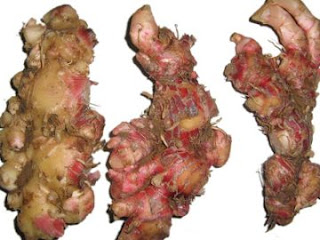
Red ginger plants are the most widely used is the rhizome sections. It is powered by a lot of red ginger rhizome store content and the effect of natural compounds as the taste spicy to taste typical red ginger itself. The content of chemical compounds consisting of a red ginger gingerol, zingeron, and shogaol. Besides red ginger contains 1-4% volatile oil and oleoresin. Essential oils in ginger red also has other compound component consisting of zingerberin, kamfena, lemonin, zingiberen, zingiberal, gingeral and shogaol and other ingredients such as petroleum resins, starch, organic acids, malic acid and gingerin aksolat. This is what makes the benefits of a red ginger widely used by many people.
Because the content of a natural compound owned quite a lot of red ginger and quite high, therefore red ginger has a myriad of exceptional benefits that are best used as a treatment, among others:
- Rhizome of ginger is widely used as a liniment for gout and headaches.
The content of other compounds contained in ginger red:
Red ginger besides containing chemical compounds also contains gingerol, 1.8-cineole 10-dehydro-gingerdione, 6-gingerdione, arginine, a-linolenic acid, aspartic, β-sitostrerol, caprylic acid, capsaicin, chlorogenis acid, farnesal, farnesene, farnesl and elements such as starch and starch, and fiber-fiber resin in small amounts.
According to some studies, the essential oil of ginger contained elements: n-nonylaldehyde, d-camphene, d-β phellandrene, methyl heptenone, cineol, d-borneol, geraniol, linalool, acetates and caprylate, citral, chavicol and zingiberene. These materials are the most important sources of raw materials in the pharmaceutical industry and medicine.
Red ginger essential oil content around 2.58 to 2.72% calculated on the dry weight. The content of essential oil of ginger is another kind of far are below. There is a large ginger or ginger rhinoceros ranged from 0.82 to 1.68% and the small ginger or ginger CVD ran ed from 1.5 to 3.3%. Essential oils are generally less viscous and yellow are compounds that give flavor to the ginger.
The amount of essential oil content is influenced by the age of the plant. That is, the older the age of the ginger is, the higher content of essential oil.
Based on the pharmacological effects, red ginger has benefits for blood circulation, boost the immune system, warm the body, anti-inflammatory and appetite enhancer and so when consumed by women who are in the menstrual period.
There are many more benefits and efficacy of red ginger for health, such as:
1. To relieve pain and stiff2. Overcoming premature ejaculation3. Stimulant activity of the central nervous4. Stimulate the ability bereksi5. Upholstery liver function6. Strengthening the immune system / immune7. Increasing the production of normal lymph8. Prevent infertility9. Strengthen the endurance of sperm10. Stimulate improvement and development of the bodys nerves11. Body warmers12. Regenerate skin cells13. Prevents premature aging14. Anesthetic15. Preventing and treating colds16. Laxatives or drug used to treat constipation or Chapter17. Antirheumatic18. Overcoming sore throat (bronchitis)19. To relieve muscle pain, allergies, menstrual pain, stomach pain20. To relieve back pain21. Overcoming impotence22. Stamina enhancer23. Treating dizziness and tonsils24. Addressing and treating asthma
Compounds and benefits of red ginger is great for the body to be salkah jaloan alternative traditional medicine for health. Therefore, it is not uncommon these people today that use a lot of red ginger.
Subscribe to:
Posts (Atom)

